I wish to share with you a few pages from our school magazine with examples of work from year 6 to year 9, which are now on display in our gallery in the Palacio. These pages were published on the Lighthouse magazine two weeks ago.
Showing posts with label ceramics. Show all posts
Saturday, 31 January 2015
Monday, 3 November 2014
Francisco Zhan
Francisco completed his IB at St. Julian's in 2012. He was a brilliant Art student and went to study a Foundation year in Art and Design at Falmouth. He is now studying at Goldsmiths in London.
Francisco wrote to the Art Department Blog updating us on his experience as an art student and sent us some examples of his work. Thank you Francisco, it is so great to hear from you!
"Hello my name's
Francisco. I study BA Fine Art at Goldsmiths University in London. Personal
statements don’t fit my work, so instead I give you this:
~
Fake tourism
Acquired taste
Very present very useless
home to the homeless, the
single
motherland
Peas not peace
...s
~
In art school, I'm
allocated an individual studio space which I can use anytime. I'm free to learn
skills in any of the specialist workshops: wood, metal, casting, ceramics,
photography, textiles, printmaking, sound and multimedia. I present my work
several times a term to peers and tutors, who are practising artists. I have
lectures on visual cultures and write essays in response.
Everybody in the course
comes from different countries and arts teaching backgrounds; for instance I
know a guy in first year who so far has been an actor, stage engineer and
primary school teacher. For the first time he is now painting. Somebody else
has been trained their entire life in classical painting and is now giving it a
go at making an installation with sea salt and toy figurines to express an idea
that wouldn’t otherwise be possible. As the course is open and entirely
self-directed, it’s most enriching to literally learn from each other.
Often students collaborate
to organise exhibitions and performance events outside of art school to show
their work - the school is happy to lend some equipment to mount shows.
I graduate next year. In
the future I hope to be a practising artist. Or a writer. Or a curator. Or an
interior or fashion designer. Or a carpenter. Or an educator. Or a tour guide.
Or a masseuse. Or a something else that doesn't yet have a name. Or all of the
above.
At best, one would hope
to graduate from an art course with the technical confidence to produce any
object, image or performance they have in mind; a sensibility to be able to
sustain a creative contemporary practice (whether or not an art practice); and a
knowledge of marketing strategies. However, like in any course, you only get as
much as you make of it. So neither art nor any other course is ever an easy way
out. To study a degree is to take a subject seriously. And to love it."
![]() |
| Video: http://vimeo.com/zhanfrancisco/idontknowhowtoknit |
Sunday, 26 October 2014
Tuesday, 21 October 2014
Explosion in the Art Department
Yesterday morning we opened the kiln door and found this....
I cannot really describe how it felt to see this, but what we had put in there the day before were three sculptures, one of which was a ring by Mariana Botte in year 13:
Needless to say, Mariana was heartbroken, and so was the whole staff who watched her spend weeks working on the details on this piece. Today, early in the morning I found her and convinced her to work on a new piece, not necessarily the same, but hopefully as interesting. Mariana made a huge effort to overcome her disappointment and a new piece is indeed being created. I hope I can share an image of it intact after firing it at half term.
Luckily there are some stunning photographs if this ring. These things happen but we are never really prepared. Another piece in the kiln was a sculpted guitar by one of our year 11 students, the second version of a previously exploded guitar... Today we carved a third version.
Whatever happens...we do not give up!
Saturday, 4 October 2014
glass and glaze
Below are two images of a recent sculpture by Paola Kassakowska. One was taken before it was fired and the other is a detail of the glazed surface of the face. In case some of our viewers are not familiar with the word "glaze", here is the basic description of what glaze is made of (from wikipedia)
Ceramic glaze raw materials generally include silica, which will be the main glass former. Various metal oxides, such as sodium, potassiumand calcium, act as a flux to lower the melting temperature. Alumina, often derived from clay, stiffens the molten glaze to prevent it from running off the piece. Colorants, such as iron oxide, copper carbonate or cobalt carbonate, and sometimes opacifiers such as tin oxide orzirconium oxide, are used to modify the visual appearance of the fired glaze.

It is still not obvious, how glaze works, unless one is familiar with glass. I leave you a beautiful film where you can see how glass behaves in the making. A contrast between the traditional glass making and the industrial machines that produce glass items en masse.
Glas Glas won master film maker Bert Haanstra a well-deserved Academy Award® for Best Short Documentary in 1959. The film contrasts the production of hand made crystal from the Royal Leerdam Glass Factory with automated bottle making machines in the Netherlands. An industrial film with a bebop heart, its lyrical use of light and sound still looks and sounds fabulous, nearly 60 years after it was made. Director Biography: Bert Haanstra (May 1916 – October 1997), was an internationally acclaimed Dutch film maker with a career spanning four decades. Though he made several forays into fictional cinema, it is his documentaries, which cast a sidelong and often idiosyncratic glance at the human animal, for which he is best known. Director: Bert Haanstra Producer: Government of the Netherlands Running Time: 10 minutes Website: www.berthaanstra.nl/english.html
Ceramic glaze raw materials generally include silica, which will be the main glass former. Various metal oxides, such as sodium, potassiumand calcium, act as a flux to lower the melting temperature. Alumina, often derived from clay, stiffens the molten glaze to prevent it from running off the piece. Colorants, such as iron oxide, copper carbonate or cobalt carbonate, and sometimes opacifiers such as tin oxide orzirconium oxide, are used to modify the visual appearance of the fired glaze.
It is still not obvious, how glaze works, unless one is familiar with glass. I leave you a beautiful film where you can see how glass behaves in the making. A contrast between the traditional glass making and the industrial machines that produce glass items en masse.
Glas Glas won master film maker Bert Haanstra a well-deserved Academy Award® for Best Short Documentary in 1959. The film contrasts the production of hand made crystal from the Royal Leerdam Glass Factory with automated bottle making machines in the Netherlands. An industrial film with a bebop heart, its lyrical use of light and sound still looks and sounds fabulous, nearly 60 years after it was made. Director Biography: Bert Haanstra (May 1916 – October 1997), was an internationally acclaimed Dutch film maker with a career spanning four decades. Though he made several forays into fictional cinema, it is his documentaries, which cast a sidelong and often idiosyncratic glance at the human animal, for which he is best known. Director: Bert Haanstra Producer: Government of the Netherlands Running Time: 10 minutes Website: www.berthaanstra.nl/english.html
Wednesday, 17 September 2014
The making of an Elephant....
Carolina de Pontes has just completed an outstanding stoneware sculpture of an elephant. This was her creative response to the theme "FORCE"
![]() |
| The finalised sculpture |
Thursday, 19 June 2014
Ceramics in year 8
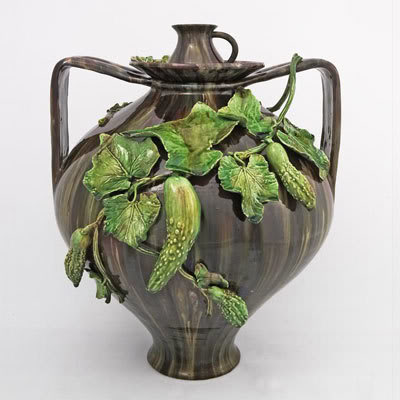
Awhile ago, in 2009, we explored ceramics in year 8, as we usually do in most year groups actually. I used a portuguese artist called Rafael Bordallo Pinheiro as a source of inspiration. Most people in Portugal are extremely familiar with this common design:
Bordallo Pinheiro designed the well known cabbage motif that exists in the shape of bowls and plates but that was just a simple and more commercial design which has been produced in mass in the well known factory of Caldas da Raínha. Bordallo Pinheiro was also a very famous satirical cartoonist in the late 19th century. (look at examples of his work here)
I focused on more elaborate pieces such as the ones below, to inspire ou year 8 students to create their own pots and decorate them with animal or vegetable elements.

Here are the fabulous pots our talented students created:


Bordallo Pinheiro designed the well known cabbage motif that exists in the shape of bowls and plates but that was just a simple and more commercial design which has been produced in mass in the well known factory of Caldas da Raínha. Bordallo Pinheiro was also a very famous satirical cartoonist in the late 19th century. (look at examples of his work here)
I focused on more elaborate pieces such as the ones below, to inspire ou year 8 students to create their own pots and decorate them with animal or vegetable elements.

Here are the fabulous pots our talented students created:


Sunday, 25 May 2014
Ceramics in the making
I have shown you some images of finalised ceramics. I thought it would also be interesting to show you images of process. Here is Olivia's head being made. It is constructed over a mod roc cast of her face and head. Olivia is in year 10!
Ceramics in IB
Here is a selection of ceramics from our IB students.
![]() |
| Agata Woloszyn made a cast of her face with mod roc and then pressed a slab of stoneware to make this piece. The piece was fired and then glazed and partially sprayed in the end. |
![]() |
| Here is a very large pot built with coils in stoneware. The image was painted with slip while the pot was leather hard and then glazed. By Melissa Speake |
![]() |
| This is a skull carved in stoneware by Ana Delgado. It was glazed at high temperature |
![]() |
| Another pot by Melissa Speake, coloured with green and white slip and then glazed. |
Subscribe to:
Posts (Atom)


.jpg)